New national rural housing policy may create clearer pathways for one-off rural homes, compact homes, refurbishment and family-support accommodation, depending on site location and local policy mapping.
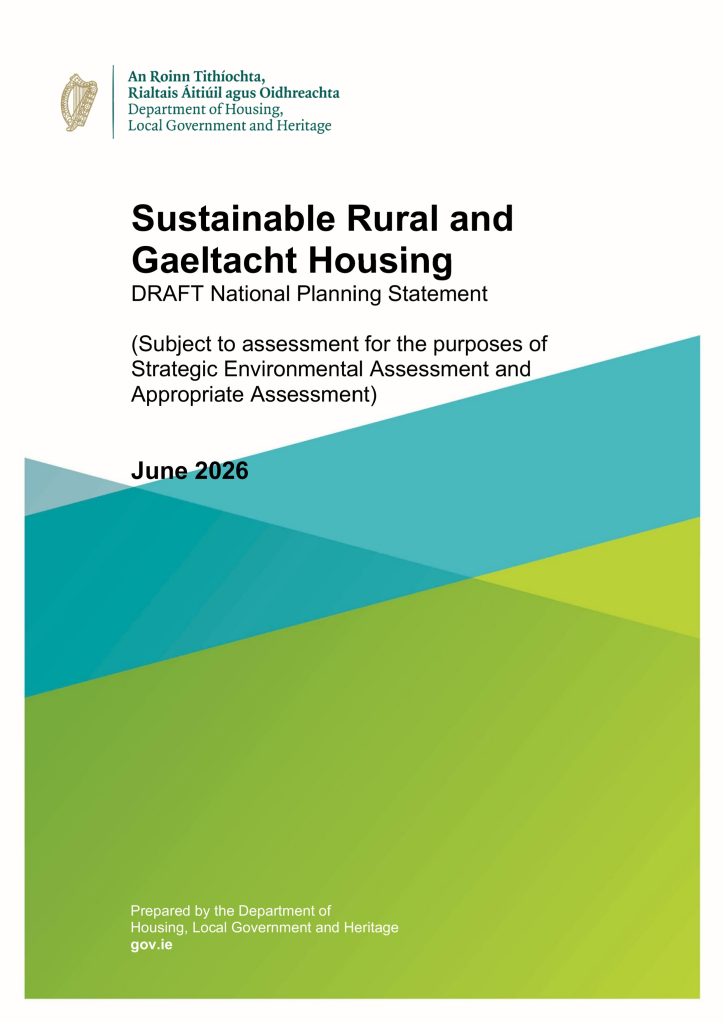
Main practical takeaways for rural housing in Meath
- The biggest possible relaxation is for “Wider Rural Areas”. If a Meath site is mapped outside Rural Areas Under Urban Influence and outside high amenity/sensitive areas, the Draft NPS wording suggests local need should generally not apply.
- Urban-influenced areas will remain controlled. Meath has a lot of commuter-belt pressure, so many sites may still fall under local economic/social need requirements.
- Ribbon Development. The interpretation has changed from: “Ribbon development is partly identifiable by a fixed numerical road-frontage test.” to: “Ribbon development is a planning impact to be assessed on the merits of the individual proposal.” For rural housing practice, this is potentially important. It gives more room to argue for carefully designed rural infill, cluster or backland proposals, especially where a council might otherwise rely heavily on the old “five houses in 250 metres” test. But the NPS still supports refusal of genuinely inappropriate roadside sprawl, particularly where it affects settlement edges, infrastructure, road safety or rural character.
- Family-tie wording is likely to become less central. The Draft NPS expressly moves away from blood-line/family-tie criteria and toward non-discriminatory local social/economic need tests.
- Applicants may benefit from clearer distance/duration tests. The Draft NPS gives measurable parameters such as 10 km / 7 years, with stricter variations in high-pressure areas.
- Remote working alone will not be enough. A person working remotely for an urban-based job would not, by itself, meet economic need under the NPS.
- Rural enterprise arguments may broaden. The NPS recognises a wider range of rural-based enterprises and discourages narrow definitions of farmer/farm.
- Reuse/refurbishment of vacant or vernacular dwellings is strengthened. This could become a useful planning route, especially where new-build local need is harder to establish.
- Compact/adaptive housing may become a niche opportunity. The NPS contains specific language around older persons, disabled persons, auxiliary accommodation, family support and accessible single-storey dwellings up to 90 sq m in certain cases.
- Technical planning standards remain critical. Sightlines, wastewater, flooding, landscape, biodiversity, heritage and design will still make or break applications.
NEW BUILDING EXEMPTIONS
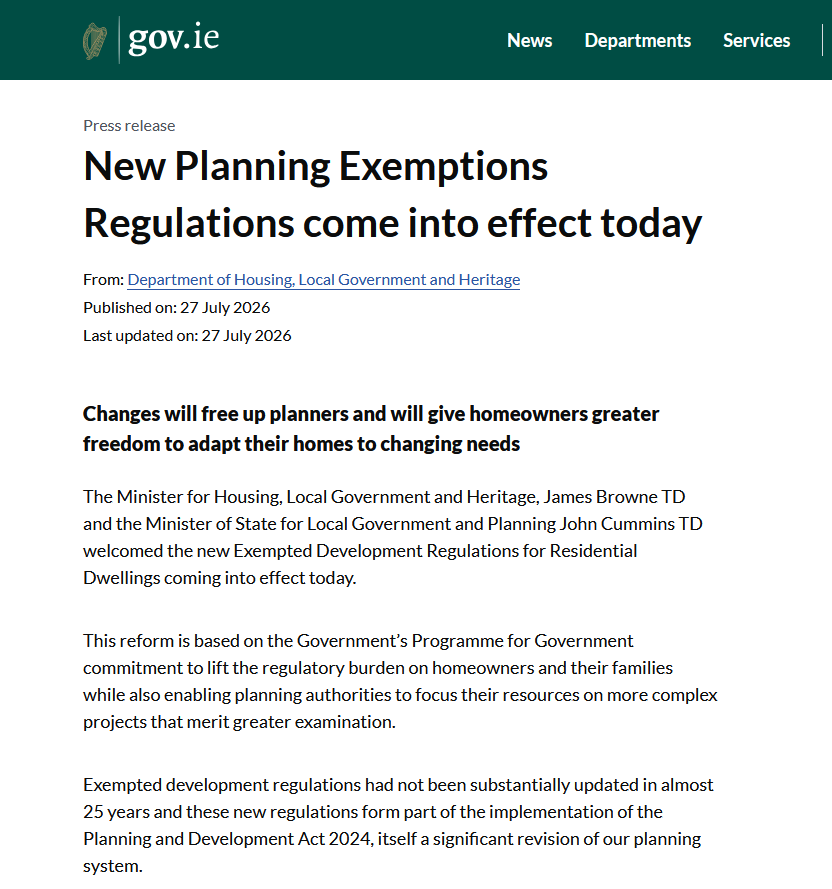
Dwellings in Rear Gardens
These are the main criteria for being able to build a habitable structure in your back garden:
- You must avail of this exemption before December 31st 2030
- Building Regulations for a dwelling still apply
- Cannot be a mobile home or caravan – has to be permanent
- Height max. 4m with hipped roof or 3m for a flat roof
- For a Semi-detached house can be any size not exceeding 45sqm
- For a detached house has to be min. 32sqm and max. 45sqm
- Rear garden must have at least 25sqm of left-over open space
- You cannot have subdivided your existing house into two units under Class 1A of these new regulations
- No new entrance to the site is allowed – existing only to be used
- Sewage and Mains Water or well connection has to be onsite – not a separate connection
- If you have a WWTS(Waste Water Treatment System) you can connect into it provided it has the capacity to take the extra loading and you cannot build on any existing percolation area.
- The dwelling has to be at least 600mm from a party or boundary wall – at this distance a window facing the boundary is also allowed.
- No New entrances from the public road can be added
- You must notify the local authority that you plan to use this exemption 14 Days before commencement of the works.
- You cannot rent out or lease the property.
Subdivision of an Existing Dwelling
What you can and cannot do:
- You must avail of this exemption before December 31st 2030
- Building Regulations for a dwelling still apply
- You can sub-divide into no more than 2 Units
- Each unit must be min. 32 sqm
- Only shared access is allowed – all other spaces & services must be self-contained
- Cannot use this Exemption if you have built a new dwelling in your rear garden as per a Class 3A exemption
- No new entrances from the public road can be added
- You must notify the local authority that you plan to use this exemption 14 Days before commencement of the works.